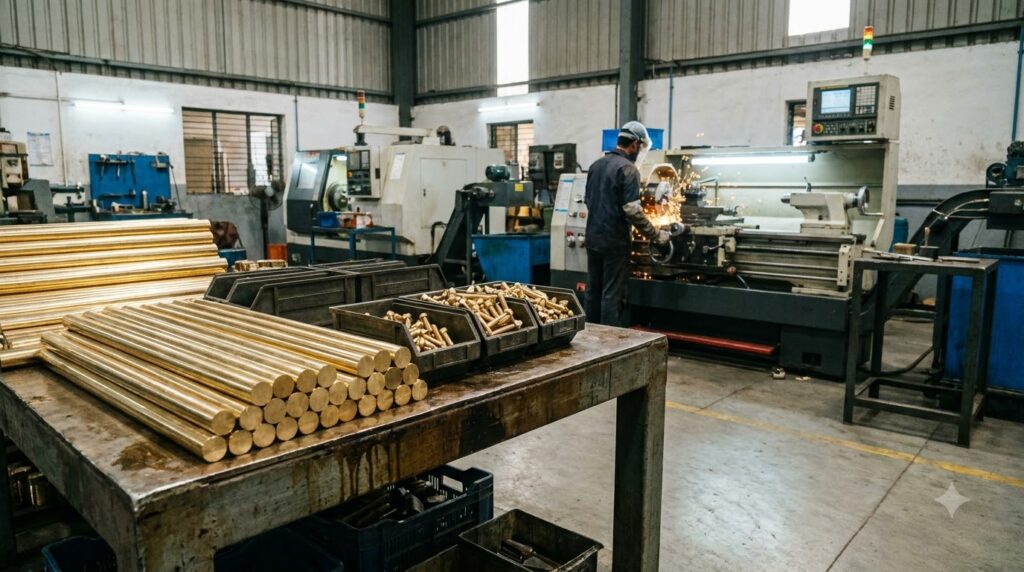
The Daily Engine of Jamnagar’s Metal Clusters
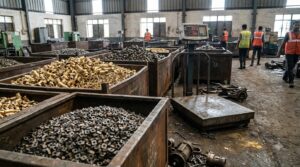
The real strength of Jamnagar lies in how closely connected every stage of production is on the ground. In industrial belts such as GIDC Dared and Shankar Tekri, material moves quickly from one specialized unit to the next without the delays typical of decentralized manufacturing centers. Local yards bring in high-grade brass scrap alongside virgin copper and zinc, which are melted in induction furnaces to cast billets tailored to exact customer needs.
Once those billets cool, hydraulic extrusion presses force the heated metal through precision dies to produce continuous round bars, hexagonal profiles, square rods, and hollow tubing. From there, thousands of lathe setups, CNC turning centers, and multi-spindle automatic machines run around the clock to cut threads, mill faces, and drill holes down to exact millimeter fractions. Because chemical testing laboratories, tool-and-die makers, and plating facilities operate right next door, raw stock turns into finished export-ready hardware without costly transit steps.
Understanding Different Brass Grades and Their Jobs
A frequent headache for buyers is placing an order for general commercial brass without matching the alloy composition to the machining process or final working conditions. Free cutting brass, widely known under the IS 319 standard, is the everyday favorite for automated lathe shops. Formulated with a balanced blend of copper and zinc alongside roughly two to three percent lead, it allows machine cutters to shear clean chips instead of creating long strings of metal that jam tooling. This grade works best for cable glands, electrical switchboard inserts, threaded hex nipples, and meter fittings.
Forging brass contains a higher share of copper and a much lower lead content, giving it the ductility needed to withstand extreme pressure and heat inside forging presses without developing internal hair cracks. Valves, heavy pipe elbows, and solid door pull handles demand this alloy so they do not snap under mechanical stress. When installations face salty air or demanding outdoor weather, lead-free or dezincification-resistant alloys step in to prevent corrosion from eating away at the core metal over time.
What Comes Out of Our Jamnagar and Rajkot Facilities
Our manufacturing and supply work covers both primary metal stock and finished architectural fittings. For industrial machine shops and assembly lines, we supply extruded brass round rods, hexagonal rods, flat bars, and hollow pipes cut to custom lengths so clients avoid paying for metal they would otherwise trim off as waste. We also produce precision-turned turned parts such as threaded bushings, sanitary spindles, brass flare nuts, and custom components machined strictly to technical drawings.
On the architectural hardware side, our operations in Rajkot focus heavily on the finished appearance and mechanical feel of residential and commercial door hardware. Solid brass door handles, passage knobs, dummy levers, and security pull handles are cast and hand-finished to handle years of daily use in modern homes, hotels, and offices. In addition, we deal regularly in clean carbide scrap and sorted brass scrap, helping foundries and recycling mills secure dependable feed material at fair local market rates.
Why Sourcing Straight from the Factory Makes Sense
Purchasing straight from a Gujarat manufacturer removes several layers of middlemen, stockists, and trading agents who each add their own markups and transit delays. When dealing directly with the plant, your team can request specific outer diameters, wall thicknesses, and alloy balances instead of settling for whatever standard inventory sits on a distributor shelf. If a part needs a specific hardness rating to prevent thread stripping during installation, the foundry can adjust its cooling process to hit that exact spec.
Direct communication also means you get transparent material test reports. When you know the exact copper, zinc, and impurity levels before delivery, your CNC operators face fewer broken tools and your scrap rates stay low. For major residential developments or ongoing industrial supply contracts, this reliability protects project budgets and keeps delivery schedules intact.
Checking Quality Before Approving Your Shipment
Before signing off on bulk brass supplies, make sure your team inspects a few key points. Check the surface of extruded rods to verify they run straight and show no visible surface cracks, scale buildup, or uneven pull marks. Have a sample piece turned on your machine to verify that chips break away neatly without excessive heat buildup on the cutter tips. Always ask for a spectrometer chemical report to confirm that copper content stays within the required fifty-eight to sixty-one percent range for standard machine stock, because any unauthorized cheapening of the alloy will leave the metal brittle and prone to failure.
Whether you run a fabrication workshop in need of regular rod deliveries or you are sourcing luxury architectural door handles for an upcoming construction project, Dwarkadhish International is equipped to handle your specifications. Our manufacturing plant is located at Plot 3460, GIDC Dared, Jamnagar 361004, and our trade office operates from Mahadev Vaadi 3 Corner, Dwarka Nagari, Laxmi Nagar, Rajkot 360005. You can reach our technical sales team directly by calling +91 75758 24248 or by emailing info@dwarkadhishinternational.com to review your drawings and request a factory quotation.